Listener Perception of AI Music Reveals New Industry Challenge

Artificial intelligence continues to gain ground across the music business, but new research suggests its biggest hurdle may not be quality. It may be perception.
A series of recent consumer studies examining reactions to AI-generated music found that listeners often respond positively to tracks created by artificial intelligence, at least until they are told how the music was made. Once AI involvement is disclosed, enthusiasm drops, raising fresh questions about transparency, streaming economics, and how generative tools could reshape the industry.
The findings arrive as AI-generated music moves deeper into the mainstream and as debates around regulation, artist compensation, and creative ownership continue to intensify.
AI Music Reaches Commercial Milestones
The role of artificial intelligence in music creation has evolved rapidly over the last two years.
What was once limited to experimental demos has become commercially viable output, with AI-generated tracks now appearing on major streaming platforms and even charting internationally. A notable moment came in August 2024, when an AI-generated song entered Germany’s official charts for the first time.
At the same time, platforms like Spotify and Amazon Music continue to dominate recorded music revenue, collectively representing the majority of global streaming income.
As generative tools become more accessible, industry observers are increasingly focused on how AI-created music could impact royalty distribution and catalog competition.
Research Shows Strong Initial Listener Acceptance
Multiple consumer studies exploring reactions to AI-generated music found that listeners generally responded favorably when evaluating tracks without being told whether they were created by humans or artificial intelligence.
In blind listening tests across pop and electronic genres, AI-generated songs often performed similarly to human-created tracks. In some cases, listeners rated AI compositions more highly based purely on sound.
The shift came once disclosure entered the equation.
When participants were informed that a song had been generated by AI, replay interest declined and willingness to pay decreased. This reaction was especially pronounced among pop listeners, where artist connection and perceived authenticity often influence engagement.
The results suggest that consumer resistance may be less about the music itself and more about how audiences interpret its origin.
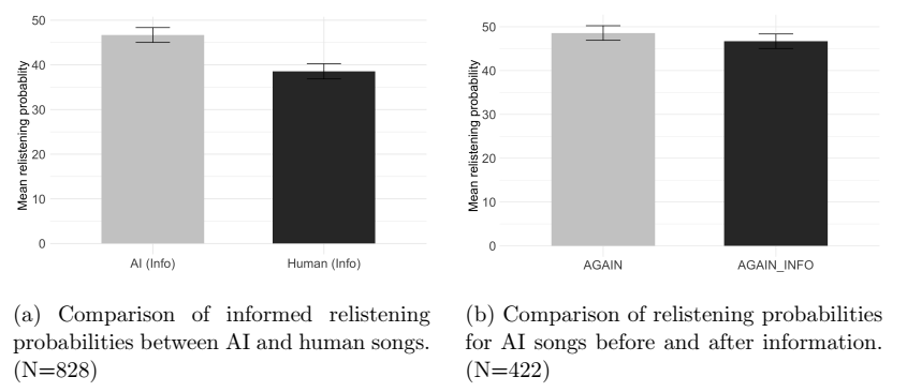
The stated likelihood to listen to a song again was on average higher for the AI-generated songs than for the human-made songs (panel a), but it decreased when the use of AI was disclosed (panel b).
Streaming Economics Face New Pressure
The emergence of tools like Google MusicLM and Suno has significantly lowered barriers to entry for music creation.
Users without traditional production experience can now generate polished tracks through text prompts, creating the potential for an unprecedented influx of content across streaming services.
For rights holders and independent artists, this raises concerns around market saturation.
Streaming royalty systems distribute payouts based on total platform activity. A dramatic increase in AI-generated uploads could dilute royalty pools, making it harder for human creators to capture meaningful revenue, even if listener demand for artist-driven music remains strong.
The issue is not necessarily whether AI songs outperform human work individually. It is whether large-scale automated output shifts the economics through sheer volume.
Transparency Moves to the Center of the Debate
The findings are adding urgency to conversations around AI labeling requirements.
Current regulatory efforts, including provisions within the European Union AI Act, aim to establish transparency standards for generative content. However, existing rules often focus on fully autonomous outputs, leaving ambiguity around hybrid workflows where AI supports but does not fully create a track.
That distinction could prove critical.
If listener behavior changes once AI involvement is disclosed, clearer labeling standards may directly affect streaming performance, consumer trust, and long-term adoption.
For labels, DSPs, and creators, transparency is quickly becoming more than a compliance issue. It is emerging as a business consideration.
The Industry’s Next Phase
For now, the research points to a complex reality.
Consumers appear open to AI-generated music when judged solely on listening experience, but many still place significant value on human authorship once that context is known.
As AI tools continue to evolve, the industry’s challenge will be balancing innovation with authenticity, while ensuring artists and audiences can navigate this new landscape with greater clarity.
The technology may be changing how music is made, but for listeners, who made it still matters.
Let’s Collaborate!
Need help building the tone for your production? Hit us up – the Rareform Audio team would love to help you create the perfect soundtrack that speaks to your audience and enhances the power of your visual storytelling to new heights!

++
Rareform Highlights


Join our Spotify Playlist and vibe with us! Featuring an array of tunes our team has been listening to.
++