Sound Design and Music in Modern Movie Trailers: Where the Line Blurs
For a long time, music and sound design had fairly distinct roles in film.
Music carried emotion, established themes, built tension, and shaped the overall feeling of a scene. Sound design handled the physical world: footsteps, doors, weapons, vehicles, explosions, environments, and other sounds that made what we saw on screen feel real.
Modern trailers have made that separation much harder to define.
A trailer might use a musical instrument as a source of harsh texture, while a sound effect such as a metal hit or engine roar becomes part of the musical rhythm. Low-frequency impacts can function like percussion, while tonal sound effects can help establish a key or harmonic movement.
The result is a trailer where it can be difficult to tell exactly where the music ends and the sound design begins.
Music Is Becoming More Textural
Traditional composition often depends heavily on melody, harmony, and recognizable instrumentation.
Modern trailer music still uses those elements, but texture has become an equally important part of the sound.
A violin might be bowed normally to create a musical phrase, then processed to produce a scraping or distorted texture. Brass instruments can be pushed into aggressive, sustained tones. Percussion can be layered with metallic impacts, processed samples, and synthesized sounds until the original source becomes difficult to identify.
This gives composers a much larger palette.
Instead of asking only, "What instrument should play this part?" the question can become, "What sound should this moment have?"
That shift is important because trailers have very little time to establish their identity. A distinctive texture can communicate tension or scale immediately, sometimes before a traditional melody has had time to develop.
Sound Effects Can Function Like Musical Elements
The relationship also works in the opposite direction.
A sound effect can serve a musical purpose.
A heavy impact might land exactly where a drum hit would normally occur. A rising mechanical sound can act like a musical riser. A deep rumble can provide the low-end weight of a bass instrument.
This is especially effective when those sounds are edited to the rhythm of the music.
Imagine a trailer sequence cutting through several fast shots. Instead of relying entirely on drums to create the rhythm, the editor might use punches, footsteps, weapon sounds, doors, impacts, and other effects to reinforce each cut.
The sound design is no longer simply supporting the picture. It is helping create the musical rhythm of the sequence.
The "Braam" Is a Good Example
One of the clearest examples of this crossover is the sound commonly referred to as a "braam," which became strongly associated with modern blockbuster trailers following Inception.
The basic idea is a huge, sustained low-frequency sound with a strong tonal quality. It can feel like a brass note, a sub-bass hit, a distorted impact, or a combination of all three.
That ambiguity is part of its usefulness.
A traditional brass note has a clear musical identity. A conventional sound effect has a recognizable physical source. A braam can sit somewhere in between.
It can provide musical weight while also functioning as a dramatic sound effect.
That same approach has spread into many other trailer techniques, where musical tones are processed until they behave more like cinematic sound effects.
Risers Have Become a Shared Language
Risers show another way these disciplines overlap.
A musical riser might be created from strings, synthesizers, percussion, or other instruments. A sound designer can create a similar effect from a recording of wind, machinery, metal, or another physical sound.
Both can accomplish the same basic job: increasing tension as a scene approaches a major moment.
The distinction becomes even less obvious when they are layered together.
A string scrape might be combined with a processed noise sweep. A tonal synth might sit underneath a mechanical sound. Several sources can be pitched, distorted, filtered, and automated until they become one evolving sound.
At that point, identifying each individual source matters less than understanding what the combined sound is doing.
Hits Can Replace Traditional Percussion
Trailer editing often relies on precise moments of impact.
A cut to a new shot, title card, character reveal, explosion, or major visual moment can all create an opportunity for a hit.
Those hits do not have to come from a conventional drum or percussion instrument.
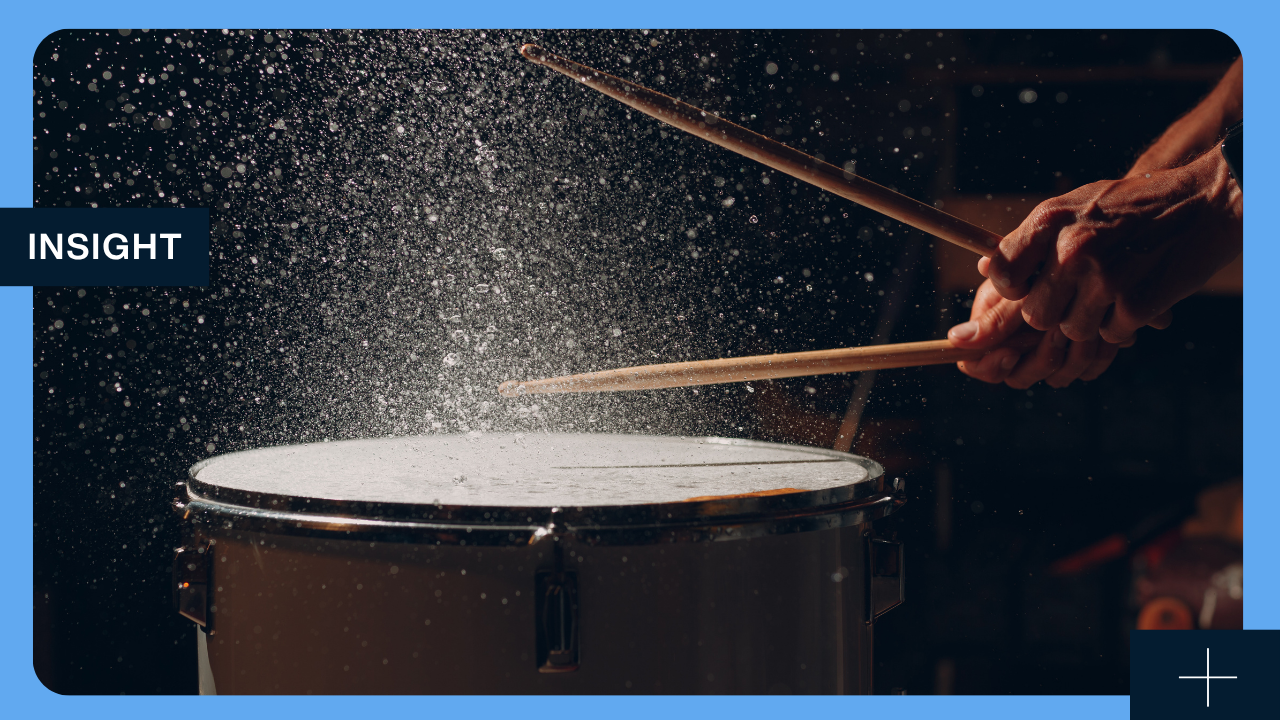
A cinematic impact might contain a bass drum, metallic recording, synthesized sub-bass, processed noise, and a short burst of distortion. It can provide the rhythmic function of percussion while also giving the picture a physical sense of scale.
This is one reason modern trailers can feel so dense.
The music may already contain percussion, while the sound design adds impacts on top of it. If those elements are carefully coordinated, they can create a strong sense of rhythm. If they are not, the mix can quickly become crowded.
Why the Combination Works So Well in Trailers
Trailers have a unique audio challenge.
They need to communicate a lot of information in a short amount of time. There may only be a few seconds to establish a mood, introduce a character, build tension, and reach a major payoff.
Combining music and sound design gives the editor more ways to control that progression.
A musical cue can establish the emotional direction. Sound design can make individual shots feel immediate. Impacts can emphasize edits. Risers can connect sections. Low-frequency elements can increase the perceived scale of a moment.
Instead of having one audio element responsible for everything, multiple elements can work together as part of the same rhythmic and emotional structure.
This Changes How Music and Sound Design Are Approached
For people working in trailers, the important takeaway is not that music and sound design have become interchangeable.
They have not.
They still solve different problems, and each discipline requires its own approach.
The change is that they increasingly share the same sonic vocabulary.
A composer may think about texture, impact, distortion, and sound effects while creating a cue. A sound designer may think about pitch, rhythm, timing, and musical structure while building effects.
That overlap means communication between the two becomes more important.
If the music already contains several large impacts, adding another layer of heavy sound design may not make the moment stronger. It may simply reduce clarity.
On the other hand, if the music leaves space for sound design to provide the physical impact, the two can feel much larger when combined.
The Mix Matters as Much as the Individual Sounds
One of the biggest lessons from this approach is that creating powerful sounds is only part of the process.
Placement matters.
If every moment contains a massive impact, constant low end, and aggressive high-frequency textures, nothing has room to stand out. The most effective trailer mixes usually create contrast by allowing certain elements to become dominant at specific moments.
A quiet section can make the next impact feel larger.
A stripped-back musical passage can give a sound effect more space.
A reduction in low end can make the return of a large bass hit feel much more significant.
This is where music editing, sound design, and mixing become closely connected. The goal is not simply to make every element as big as possible. The goal is to decide which element should matter most at each point in the trailer.
Where This Leaves the Line Between Music and Sound Design
The boundary has not disappeared. It has become more flexible.
Modern trailers demonstrate that a sound does not necessarily need to fit into one category.
A musical instrument can become a texture. A sound effect can become rhythm. A tonal impact can function as both music and sound design. A processed recording can become part of the score.
For trailer creators, this opens up more creative possibilities, but it also creates a practical challenge: the different elements need to be designed with each other in mind.
The strongest results often come from treating the soundtrack as a complete sonic system rather than thinking about music and sound design as completely separate pieces.
That is ultimately why the distinction can feel so blurred in modern trailers. The tools, techniques, and roles may still be different, but they are increasingly being used to accomplish the same goal: making a visual moment feel immediate, memorable, and impactful.
Let’s Collaborate!
Need help building the tone for your production? Hit us up – the Rareform Audio team would love to help you create the perfect soundtrack that speaks to your audience and enhances the power of your visual storytelling to new heights!

++
Rareform Highlights

++
Join our Spotify Playlist and vibe with us! Featuring an array of tunes our team has been listening to.
++